
One Screen. One Recipe. One Complete Weld.
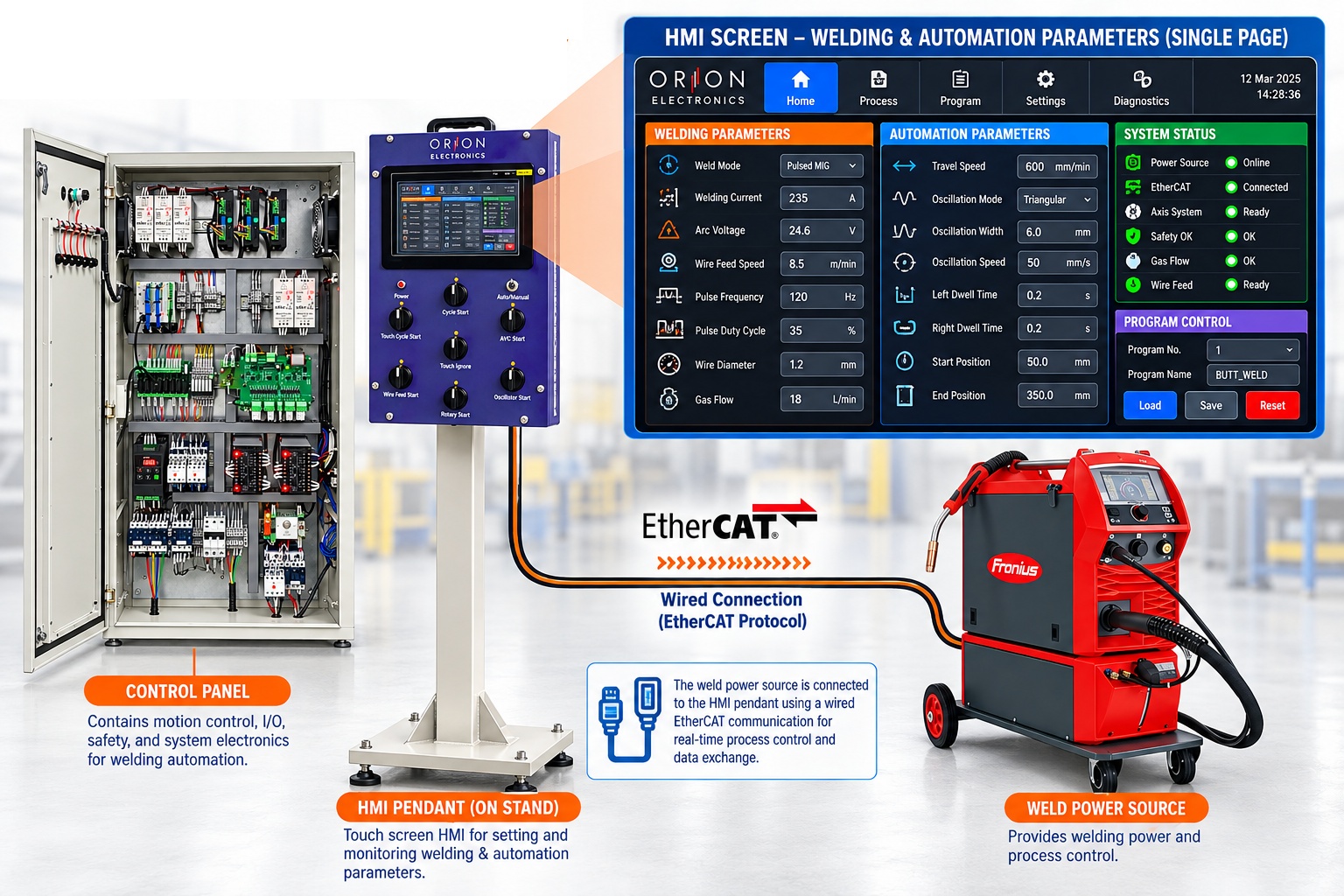
In most automated welding setups, the weld and the motion are controlled separately. The welding parameters are set on the power source. The travel speed, weaving, wire feed and torch height are set on the automation panel. Two systems, two screens, and the operator in between, trying to keep them matched.
When the job changes, both must be reset by hand. A small mismatch means a weld defect. And when a quality question comes up later, there’s no single record of how the weld was actually made.
What this means for you
One recipe for the complete part. Welding parameters and automation parameters, travel speed, weave width, dwell, wire feed and AVC settings, are saved together as a single recipe for each component. Select the part, and the whole system is ready.
Weld and motion working in step. Welding parameters can change in synchronisation with the motion: by pass, by position around the pipe, or at each weave edge. This level of control isn’t possible when the two systems run separately.
Develop the perfect parameters, then lock them in. During setup, your engineers have full freedom to adjust both weld and motion parameters on one screen and refine them through trials. Once the right combination is found, it’s saved, protected by password, and repeated exactly on every part, every shift, by every operator.
Faster changeovers. Switching between jobs takes seconds, not repeated manual settings on two machines.
Complete traceability. Actual welding and motion data are recorded together for every weld, giving you one reliable record for quality audits and customer documentation.
Less dependence on operator skill. Proven parameters are built into the system, not held in an individual’s memory.
Proven with Leading Power Sources
We’ve delivered unified control with power sources from Fronius (via EtherCAT), and Lorch and Miller (via EtherNet/IP), and our SmartWeld system with this capability is in service with a customer in the USA.
A Powerful Architecture for Welding
Unified Weld and Automation Control is particularly powerful in automated welding applications

Welding Process Control
Unified Weld and Automation Control can synchronize and control welding parameters based on the connected power source and process interface.
- Welding current & voltage
- Pre-flow & post-flow gas timing
- Current ramp-up & ramp-down
- Start/end current parameters
- Purge parameters
- Welding & arc timing
- Pulse & wire-feed settings

Multi-Pass Recipes & Data Logging
Create application-specific welding recipes and store complete multi-pass programs for repeatable production.
- Application-specific recipes
- Multi-pass welding programs
- Current & voltage logging
- Wire-feed & travel speed
- Arc-on time & process timing
- Motion & automation parameters
- Synchronized digital process records

Automation & System Integration
Unified Weld and Automation Control connects and synchronizes different automation equipment without requiring complete replacement of existing systems.
- Robots
- Customer PLCs
- Servo & stepper systems
- VFDs
- Positioners & rotators
- Vision & laser sensors
- Wire feeders
Existing Machine Integration
Add Orion’s automation capabilities to an existing machine or control system while continuing to work alongside the customer’s installed equipment.
- Integrates with existing PLCs
- Works with existing machine controls
- Synchronizes multiple devices
- Adds centralized process control
- Reduces complete system replacement
- Enables coordinated machine operation
IIoT & Connected Machines
Unified Weld and Automation Control provides the foundation for connecting machine and process data to local servers, databases or cloud platforms.
Control → Synchronization → Monitoring → Data Logging → Traceability → Analysis
- Real-time machine data
- Centralized data logging
- Process traceability
- Production monitoring
- Database & cloud connectivity
- Data-driven process analysis