
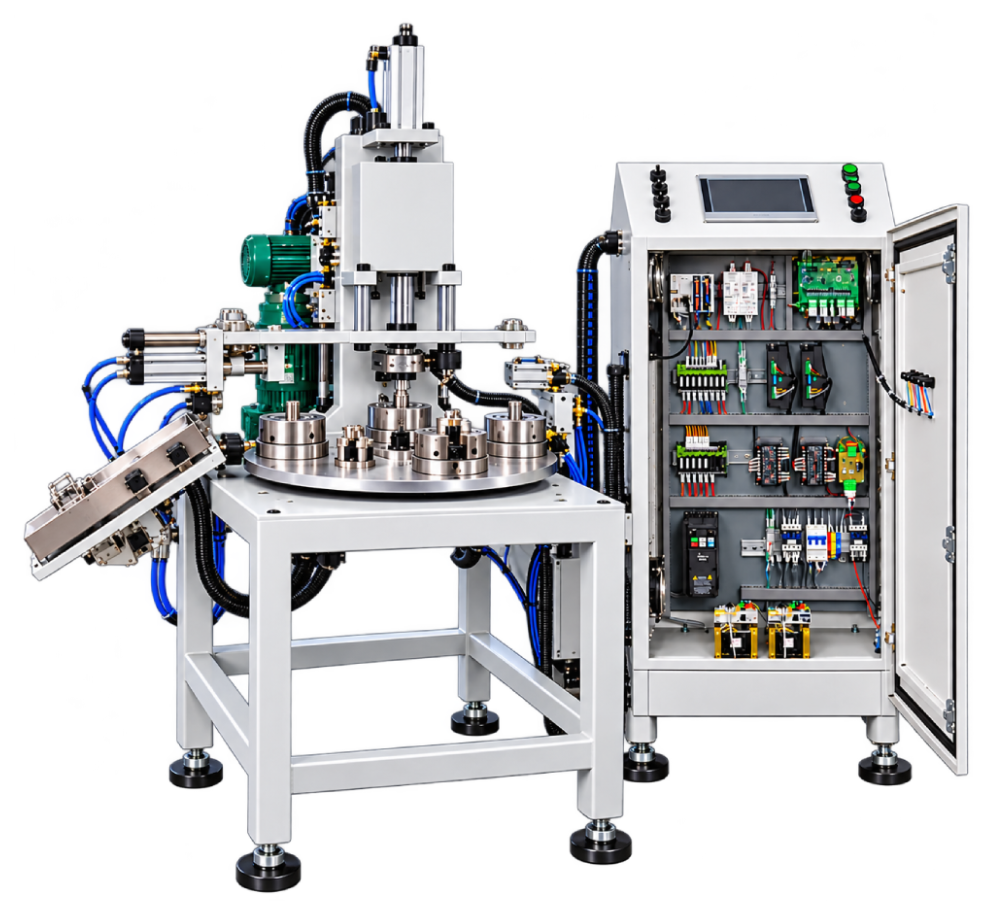
An SPM (Special Purpose Machine) for this task automatically checks the internal (ID) thread of each job using a Go/No-Go gauge and sorts parts into OK and NOT OK bins.
Working sequence
- Manual loading: The operator places the job in a fixture on the rotary table at the loading station.
- Indexing: The rotary table (driven by an indexer, geared motor, or stepper) turns the job to the checking station and locks in position with a pin or sensor confirmation.
- Clamp: A cylinder or clamp holds the job so the thread is aligned with the gauge.
- Gauge down and rotate: The stepper motor lowers and rotates the thread gauge into the ID thread. The number of turns is set to match the thread, so the gauge screws in to full depth and stops.
Turns = thread depth ÷ pitch. For example, M8 × 1.25 pitch with 10 mm depth is 8 turns.
Steps = turns × steps per rev. With 200 steps/rev and 1/16 microstepping, that is 8 × 3200 = 25,600 pulses. - Verification: The machine confirms the gauge actually reached full depth. This is the key point, because a stepper has no feedback by itself.
- Reverse and unclamp: The stepper reverses the same number of turns to back the gauge out, then the clamp releases.
- Segregation: The table indexes on to the unloading station. The PLC releases the part to the OK bin, or a pusher or diverter sends it to the NOT OK bin.
How OK / NOT OK is decided
- OK: Gauge advanced the full number of turns and reached the depth sensor or limit.
- NOT OK: Gauge stalls, jams, or does not reach full depth (undersize, damaged, burred, or blocked thread). The stepper may skip steps, or the spring-loaded gauge holder stays short of the sensor.
- Optional No-Go: A second station with a No-Go gauge that must enter no more than 1-2 turns.
Main components
- Frame and fixture/clamp
- Servo or geared motor with a gauge spindle
- Go/No-Go thread plug gauge
- Pneumatic cylinders, diverter, and chutes
- Sensors (proximity, depth, torque)
- PLC and HMI with a part counter and OK/NOT OK indication
- Safety guards, emergency stop, and a light tower
Optional features
- Alarm or machine stop after consecutive rejects
- Data logging of OK/NOT OK counts per shift
- Vision or air-gauge as an alternative to a mechanical gauge