

Challenge
A customer wanted single-pass, full-penetration welds using keyhole TIG instead of multi-pass TIG. Keyhole TIG depends on a very stable arc length, so the customer needed automatic torch height control that would stay reliable at keyhole currents.
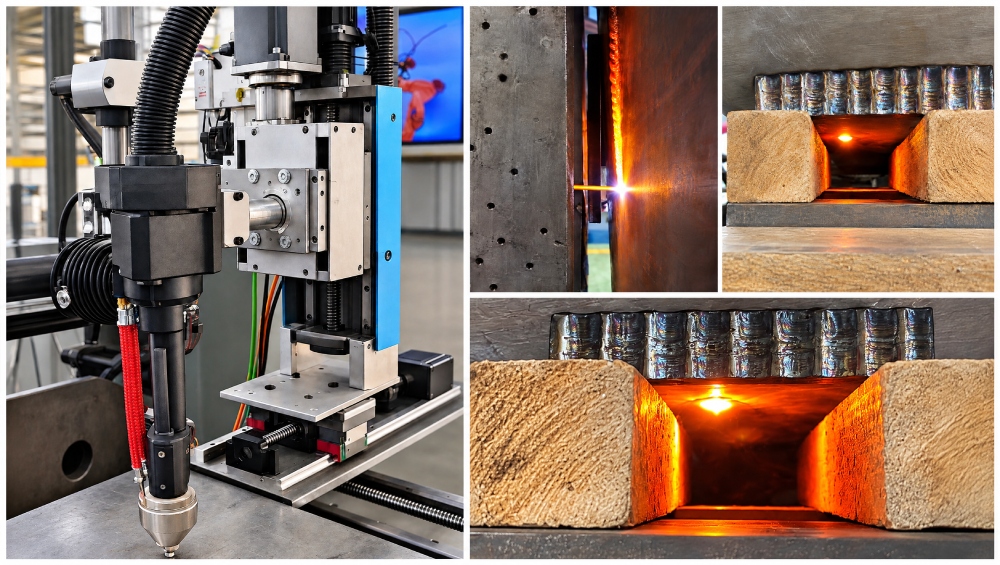

Engineering Challenges
Our AVC was tuned for conventional TIG, where arc voltage closely tracks arc length. Keyhole TIG behaves differently. At very high currents, the arc pushes through the plate and forms an open keyhole. The arc voltage then rises and fluctuates as the keyhole forms and stabilizes, even though the torch height hasn’t changed. A standard AVC reads that rise as “torch too high” and drives the torch down towards the weld pool. That risks dipping the tungsten, collapsing the keyhole, or the torch hunting up and down.

The Solution
Orion adapted the existing AVC controller rather than designing a new one. We modified its voltage sensing and control response for keyhole conditions. The controller now ignores voltage changes caused by the keyhole while still correcting real changes in torch height.

Innovation Developed
- Extended our AVC to keyhole TIG, so one controller now covers conventional TIG, keyhole TIG and plasma processes
- Developed control logic that tells real changes in arc length apart from voltage changes caused by the keyhole
- Gave Orion a proven, ready building block for single-pass, full-penetration welding systems

Outcome
The system achieved stable torch height control throughout keyhole TIG welding. It produced consistent single-pass, full-penetration welds, with a uniform bead on the root side. Adapting proven AVC technology kept development time short and widened the range of processes Orion can automate.