Every device on your machine, working as one system.
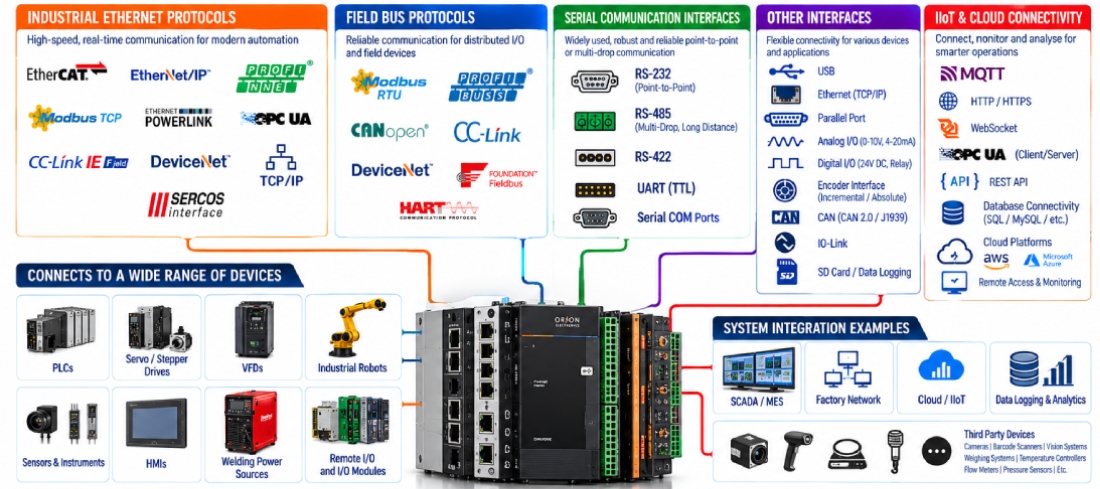
A modern machine is rarely run by one controller. PLCs, servo drives, welding power sources, robots, HMIs, sensors and vision systems all have to exchange data reliably and in real time. When they don’t, operators end up setting parameters in several places, faults are hard to trace, and production data is lost.
We connect these devices over the industrial protocols they already speak, including EtherCAT, EtherNet/IP, PROFINET, Modbus TCP/RTU and serial links, so the whole machine works from one coordinated control system. In welding, for example, we have connected Fronius power sources over EtherCAT and Lorch and Miller sources over EtherNet/IP, so weld parameters are set and logged from the same HMI that runs the automation.
The same connection gives you the data: real-time monitoring, weld and process logging for traceability, and export to plant servers or cloud systems when you need it.
Communication Technologies
Industrial Ethernet
- EtherCAT
- Ethernet TCP/IP
- Profinet
- Ethernet/IP

Serial Communication
- Modbus RTU
- RS-232
- RS-422
- RS-485
Machine Communication
- CAN Bus
- Modbus TCP
- TCP Socket Communication
- Serial ASCII Protocols
- Custom OEM Protocols
Digital Manufacturing
- IIoT Connectivity
- Cloud Data Upload
- Production Dashboards
- Remote Diagnostics
- Remote Software Updates
- Predictive Maintenance (Future Ready)
What This Makes Possible
Machine-to-Machine Communication
Synchronize multiple machines operating together within a production line.
Synchronize multiple machines operating together within a production line.
Power Source Integration
Control welding parameters directly from the operator HMI.
Control welding parameters directly from the operator HMI.
PLC Integration
Communicate seamlessly with customer PLC architectures.
Communicate seamlessly with customer PLC architectures.
Robot Integration
Exchange motion commands, process data and status information with industrial robots.
Exchange motion commands, process data and status information with industrial robots.
Servo Communication
Coordinate multiple servo drives for synchronized motion.
Coordinate multiple servo drives for synchronized motion.
Machine Vision Integration
Receive inspection data from cameras and laser sensors for intelligent machine decisions.
Receive inspection data from cameras and laser sensors for intelligent machine decisions.
Production Monitoring
Collect machine data for reporting, analysis and traceability.
Collect machine data for reporting, analysis and traceability.
Cloud Connectivity
Enable Industry 4.0 data exchange with higher-level software platforms.
Enable Industry 4.0 data exchange with higher-level software platforms.
Why It Matters?
Unlike traditional automation systems where each device communicates independently, a connected architecture establishes unified communication architecture that simplifies machine integration, reduces engineering effort, and enables scalable automation.
Benefits:
- Simplified System Integration
- Faster Commissioning
- Reduced Wiring Complexity
- Reliable Industrial Communication
- Centralized Diagnostics
- Remote Support Capability
- Industry 4.0 Ready
- Easy Future Expansion