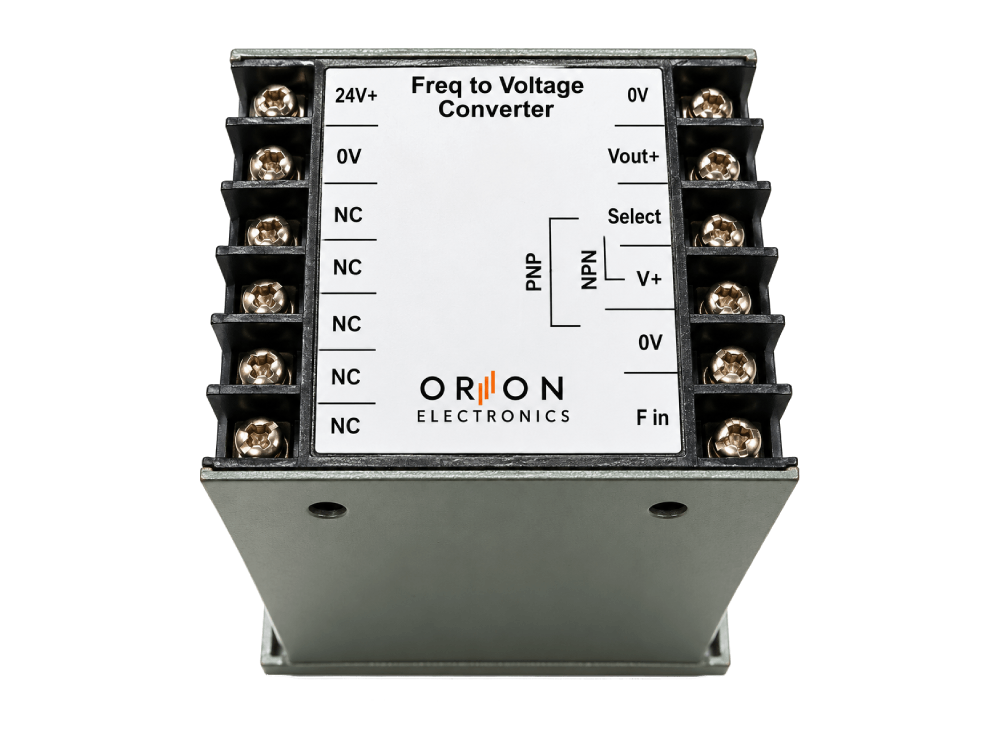
Frequency-to-Voltage Conversion – Converts an incoming pulse/frequency signal (Hz) into a corresponding analog voltage output
Pulse-Driven Speed Control Interface – Enables an existing PLC or controller generating a pulse-train output to control AC motor speed through a corresponding voltage command
Blind Controller Architecture – Compact, dedicated module with no display, keypad or operator-settable parameters
Direct Frequency Input – Accepts frequency output from an existing PLC, motion controller or other pulse-generating control system
Proportional Voltage Output – Generates a corresponding voltage signal based on the input frequency
AC Motor Speed Control Applications – Suitable for applications where the existing control system needs to command an AC motor / VFD speed reference
Plug-and-Integrate Design – Functions as an interface module between an existing pulse-output controller and the downstream motor-speed control system
No Operator Adjustment Required – Fixed-function design eliminates unnecessary parameter-setting or configuration
Rear-Mounted Connections – All input and output terminals are conveniently provided at the rear of the module
Compact Modular Construction – Small, application-specific interface module designed for easy integration into existing control panels
Standalone Interface Solution – Can be integrated into an existing automation architecture without replacing the customer’s PLC or primary controller
In simple terms:
Pulse Frequency Input (Hz) → F-to-V Converter → Proportional Voltage Output → AC Motor / VFD Speed Control