
The motion behind a perfect weld.
A welding machine is only as good as the motion that carries the torch. Getting the arc to the right place, at the right speed, weaving the right way, pass after pass, takes more than standard automation. It takes motion control written specifically for welding.
At Orion, we program the coordinated motion, intelligent sequences and process logic that turn welding machines into reliable and repeatable welding systems, from a single pipe station to robotic cells and seamless coordination with 6-axis robots or cobots until the robot cell is running.
What we do
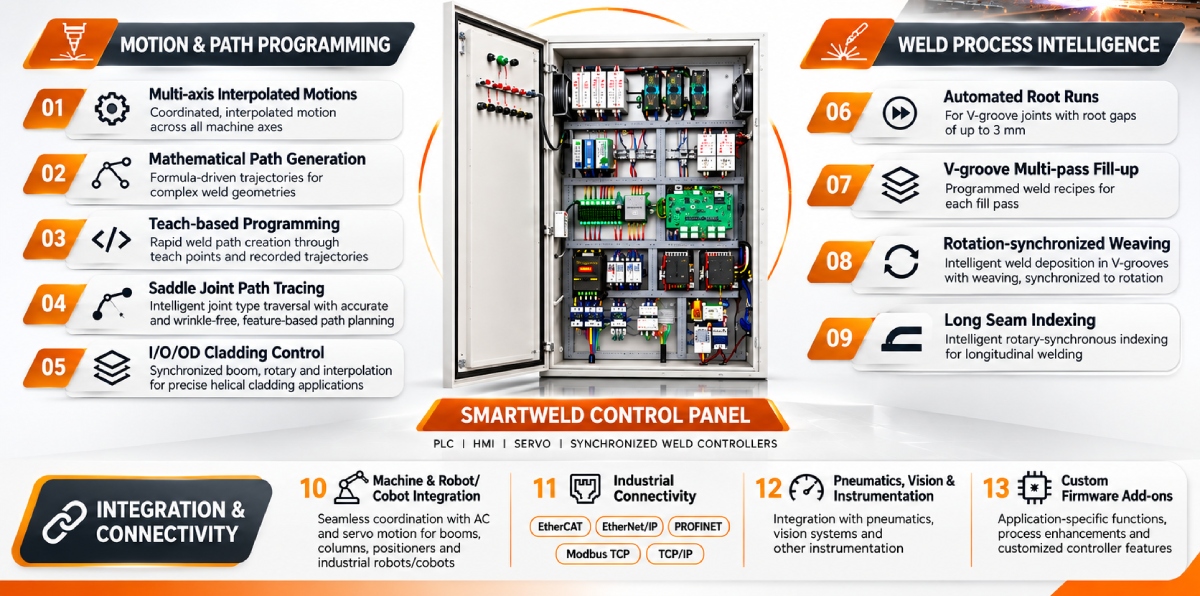
Multi-Axis Interpolated Motion
Precise coordination of two or more axes, linear-linear and rotary-linear, so the torch follows the joint smoothly at a controlled travel speed.
Mathematical Path Generation
Formula-driven trajectories for saddle joints, branch connections and other complex weld geometries. The path is calculated, not approximated, so the torch follows the true shape of the joint.
Teach-Based Programming
Create weld paths quickly by teaching points or recording trajectories, so new jobs can be set up without writing a new program.
Pipe and Groove Welding Intelligence
- Automated root run on pipes with root gaps of up to 3 mm
- Multi-pass recipes for V-groove fill-up, with parameters set for each pass
- Rotation-synchronised weaving for controlled weld deposition in V-grooves
Longitudinal Seam Welding
Intelligent long-seam indexing synchronised with weaving, for consistent bead quality along the full seam length.
ID/OD Cladding Control
Synchronised boom and rotary-axis interpolation creates precise helical cladding patterns on both inside and outside pipe surfaces, with uniform overlap and coverage.
Machine, Robot and Cobot Integration
Seamless coordination between AC- and servo-driven booms, rotators, positioners and industrial 6-axis robots or cobots, so every part of the welding cell works as one system.
Sensors, Vision and Instrumentation
Integration of sensors, vision systems and measurement instruments for tracking, inspection and process monitoring, with analog and digital I/O expansion as the application grows.
Weld start, stop and process sequence
- Gas pre-flow and post-flow control
- Arc start (HF or lift-arc) with arc-fail detection, retry or safe stop
- Up-slope, down-slope and crater fill
- Weld start-stop overlap on circumferential welds
- AVC hold during arc start, sampling delay, and AVC sampling on pulse peak only
- Wire feed start delay and wire retract at weld end
- Pulse-synchronised wire feed and weaving (for example, higher current at the weave edges)
- Hot-wire TIG control
Positional and pipe welding
- Surface travel speed held constant across different pipe diameters
- Positioner tilt-and-rotate coordination to keep the weld in the flat position
- Oval or elliptical path compensation
- Interpass temperature wait, using a temperature sensor
- Step, skip and stitch welding to control distortion
Data, quality and access
- Recipe management with password-based user levels
- Weld data logging and traceability per job or serial number
- Automatic weld reports, and QR or barcode job IDs
- Alarm history and diagnostic screens
- Remote access for support
Safety and monitoring
- Emergency stop, interlocks and light curtains
- Torch collision or breakaway sensing
- Gas flow, cooling water flow and wire-out monitoring
- Wire stick detection